Synchronicity
Synchronicity
How Fractalism understands synchronicity as a charged interruption of closed patterns, without turning every coincidence into a revelation.

Most people know the feeling of a moment that stands out before they know what to make of it.
Something appears through timing, repetition, echo, or a strange convergence between inner attention and outer event. A moment feels charged. Not necessarily because it proves a hidden mechanism, but because it interrupts the normal texture of experience and makes something newly visible.
That is the territory of synchronicity.
What synchronicity is
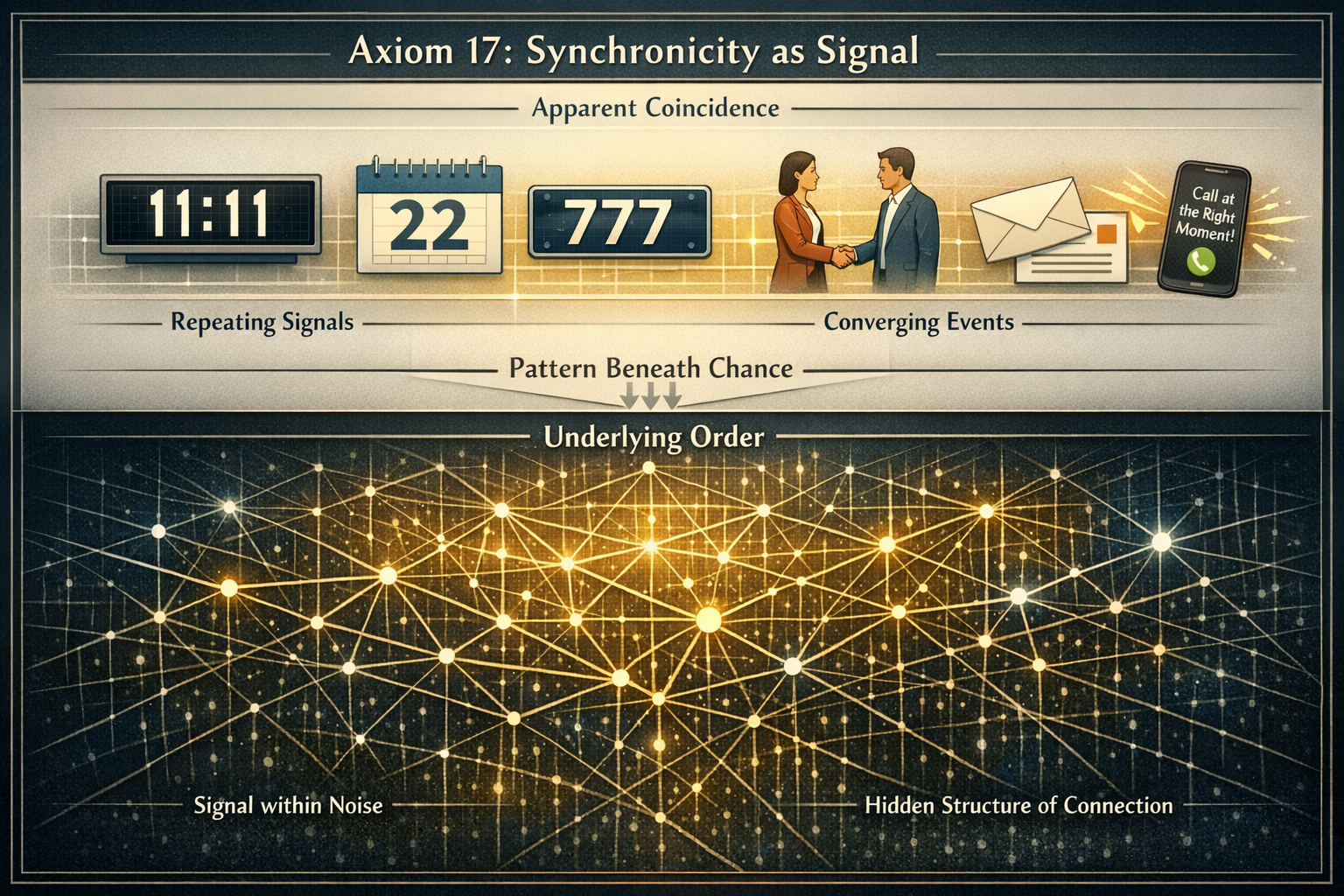
In Fractalist terms, synchronicity names a charged convergence between inner attention and outer event that feels unusually patterned or timely, while still leaving the meaning of that convergence open.
This page is mainly concerned with the experience of synchronicity and with how to read it carefully. It is not claiming to have a settled theory of what causes such moments.
A synchronicity may sharpen attention. It may expose a pattern that the person was already near, but had not yet consciously registered. It may interrupt numbness, confusion, or repetition. It may feel as if something in experience is pressing for attention.
But none of that means every charged event is a revelation, or that significance automatically proves a cosmic message.
Fractalism takes synchronicity seriously, but not naively.
Synchronicity as interruption
One reason synchronicity matters is that it sometimes appears precisely when experience is becoming closed, mechanical, or trapped inside a loop.
A person can become enclosed in confusion, compulsion, despair, self-protection, or interpretive rigidity. Everything starts to feel flattened. Attention narrows. Meaning collapses into repetition.
In those moments, synchronicity can function as a small interruption.
Not because it solves everything. Not because it guarantees truth. But because it can break the feeling that reality has become fully sealed. It can open a crack in a closed pattern and make a person notice that something more is happening than the loop itself was able to admit.
In that sense, synchronicity can be read as resistance to total enclosure.
The attention-grabbing quality of synchronicity
A synchronicity often does not feel meaningful only after long reflection. Often it arrests attention first.
Something lights up. It stands out from the background. Only afterwards does thought begin trying to understand why.
That matters. It means synchronicity is not only a neutral event that later receives interpretation. It is often an event that presents itself as salient before any full explanation is available.
This does not make the interpretation automatically correct. But it does suggest that human experience responds not only to bare facts, but also to pattern, salience, resonance, and possible meaning.
Attention sometimes seems to know that something matters before thought can explain why.
What synchronicity is not
Synchronicity does happen. It is not only the mind over-reading coincidence or finding pattern where none exists. There is something to these moments that resists that reduction, and Fractalism takes that seriously before anything else.
Experience and interpretation
A useful distinction matters here.
A synchronicity can be real as an experience without automatically being true as an explanation.
The moment itself may genuinely matter. It may affect attention. It may reveal a state of readiness, a pattern of concern, or a shift in perception. But the interpretation you attach to it can still be wrong, exaggerated, or premature.
Fractalism therefore treats synchronicity as a clue, not a verdict.
Pattern overlap as a speculative image
One way of thinking about synchronicity is as a moment where patterns that are usually experienced separately cross in a way that feels newly salient. Not a supernatural message, not mere projection, but a real convergence that registers in experience precisely because different layers of pattern seem to touch at the same point.
On that reading, synchronicity is not a violation of reality’s order. It may be a brief point where different layers of experience, timing, and relation seem to touch in a way that stands out. The value of this image is not merely interpretive. It names something that happens, and it does so without pretending to resolve why.
What synchronicity suggests about experience
If synchronicity is a real recurring feature of human experience, then it suggests at least this much: experience is more layered than a flat model of consciousness can easily describe.
People do not register only objects and events. They also seem to register pattern, resonance, salience, shifts in field quality, and possible direction or meaning. That is already a serious observation. It does not require a total metaphysical system to become interesting. It only requires acknowledging that consciousness may be more sensitive to structure than a purely flat account of experience allows.
How to read synchronicity well
A better question than, “What secret message is the universe sending me?” is this:
“What is becoming visible to me through this moment?”
That question keeps the event open. It does not flatten it into dismissal, but it also does not inflate it into certainty.
If a synchronicity makes you clearer, steadier, more honest, or more able to see the pattern you are living inside, then it may be doing real work.
If it makes you grandiose, obsessive, or less reality-based, then something in the reading has probably gone wrong.
Even a helpful reading should not be mistaken for proof. A moment can clarify attention without settling the truth of the interpretation attached to it.
Read carefully, synchronicity tends to increase honesty, proportion, and contact with reality. Apophenia tends to multiply meanings without limit, flatten doubt, and make every coincidence feel confirmatory.
Closing
Synchronicity belongs in Fractalism because Fractalism is concerned with how pattern becomes visible.
Sometimes that happens through argument. Sometimes through slow recognition. Sometimes through a charged interruption that makes a closed pattern briefly less closed.
The task is not to worship such moments.
The task is to read them carefully.
For a practical case study in acting on a synchronicity, see Acting on a Synchronicity.
Link to this page
https://fractalisme.nl/synchronicity/